Sunday, April 23, 2017

Why Does North Korea Want Nukes?
 
“Why has this tiny nation of 24 million people invested so much of its limited resources in acquiring nuclear weapons?... 

North Korea’s stance cannot be separated out from its turbulent history during the 20th Century, especially its four decade long occupation by Japan, the forced division of the Korean peninsula after World War II, and, of course, the subsequent utterly devastating war with the United States from 1950-1953 that ended in an armistice in which a technical state of war still exists…

…Japan surrendered on 15 August when Soviet troops had occupied much of the northern peninsula. It should be noted that American forces played no role in the liberation of Korea from Japanese rule. However, because the Soviets, as allies of the U.S., wished to remain on friendly terms they agreed to the division of Korea between Soviet and American forces…

The Soviets could easily have occupied the entirety of Korea but chose not to do so, instead opting for a negotiated settlement with the U.S. over the future of Korea. Theoretically the peninsula would be reunited after some agreement between the two victors at some future date.

However, the U.S. immediately began to favor those Koreans who had collaborated with the Japanese in the exploitation of their own country and its people, largely the landed elites, and Washington began to arm the provisional government it set up to root out the peoples’ committees. 

For their part the Soviets supported the communist nationalist leader, Kim Il-Sung who had led the guerrilla army against Japan at great cost in lives.

In 1947 the United Nations authorized elections in Korea, but the election monitors were all American allies so the Soviets and communist Koreans refused to participate. By then the Cold War was in full swing, the critical alliance between Washington and Moscow that had defeated Nazi Germany had already been sundered. 

As would later also occur in Vietnam in 1956, the U.S. oversaw elections only in the south of Korea and only those candidates approved by Washington. Syngman Rhee became South Korea’s first president protected by the new American armed and trained Army of the Republic of Korea. This ROK was commanded by officers who had served the Japanese occupation…

On both sides of the new artificial border pressures mounted for a forcible reunification. The fact remained that much of rural southern Korea was still loyal to the peoples committees. This did not necessarily mean that they were committed communists but they were virulent nationalists who recognized the role that Kim’s forces had played against the Japanese. Rhee’s forces then began to systematically root out Kim’s supporters…

In 1948 guerrilla war broke out against the Rhee regime on the southern island of Cheju, the population of which ultimately rose in wholesale revolt. The suppression of the rebellion was guided by many American agents soon to become part of the Central Intelligence Agency and by military advisers…between 20,000 and 30,000 villagers died. 

Simultaneously elements of the ROK army refused to participate in this war against their own people and this mutiny was brutally suppressed by those ROK soldiers who would obey such orders. Over one thousand of the mutineers escaped to join Kim’s guerrillas in the mountains…

In 1950 Washington issued its famous National Security Paper-68 (NSC-68) which outlined the agenda for a global anti-communist campaign, requiring the tripling of the American defense budget…

The Korean War seemed to vindicate everything written and said about the” international communist conspiracy. In popular myth on June 25, 1950 the North Korean Army suddenly attacked without warning… In fact the entire 38th Parallel had been progressively militarized and there had been numerous cross border incursions by both sides going back to 1949…

The Korean civil war was all but inevitable. Given postwar American plans for access globally to resources, markets and cheaper labor power any form of national liberation, communist or liberal democratic, was to be opposed… 

Truman decided to request authorization for American intervention from the United Nations and bypassed Congress thereby leading to widespread opposition and, later, a return to Republican rule under Dwight Eisenhower…

The war went badly at first for the U.S. despite numerical advantages in forces. Rout after rout followed with the ROK in full retreat. Meanwhile tens of thousands of southern guerrillas who had originated in peoples’ committees fought the Americans and the ROK. 

At one point the North Koreans were in control of Seoul and seemed about to drive American forces into the sea. At that point the commander- in-chief of all UN forces, General Douglas MacArthur, announced that he saw unique opportunities for the deployment of atomic weapons…

Truman was loathe to introduce nukes and instead authorized MacArthur to conduct the famous landings at Inchon in September 1950…This threw North Korean troops into disarray and MacArthur began pushing them back across the 38th Parallel, the mandate imposed by the UN resolution. But the State Department claimed that the border was not recognized under international law and therefore the UN mandate had no real legal bearing. 

It was this that MacArthur claimed gave him the right to take the war into the north. Though the North Koreans had suffered a resounding defeat in the south, they withdrew into northern mountain redoubts forcing the American forces that followed them into bloody and costly combat, led Americans into a trap.

The Chinese had said from the beginning that any approach of foreign troops toward their border would result in “dire consequences.” 

Fearing an invasion of Manchuria to crush the nascent communist revolution the Chinese foreign minister, Zhou En-Lai declared that China “will not supinely tolerate seeing their neighbors invaded by the imperialists.” 

MacArthur sneered at this warning. “… They have no airforce…if the Chinese tried to get down to Pyongyang there would be a great slaughter…we are the best.” He then ordered airstrikes to lay waste thousands of square miles of northern Korea bordering China and ordered infantry divisions ever closer to its border.

It was the terrible devastation of this bombing campaign, worse than anything seen during World War II short of Hiroshima and Nagasaki that to this day dominates North Korea’s relations with the United States and drives its determination never to submit to any American diktat.

General Curtis Lemay directed this onslaught. It was he who had firebombed Tokyo in March 1945 saying it was “about time we stopped swatting at flies and gone after the manure pile.” It was he who later said that the US “ought to bomb North Vietnam back into the stone age.” Remarking about his desire to lay waste to North Korea he said “We burned down every town in North Korea and South Korea too.” Lemay was by no means exaggerating.

On November 27, 1950 hundreds of thousands of Chinese troops suddenly crossed the border into North Korea completely overwhelming US forces…

Panic took hold in Washington. Truman now said use of A-bombs was under “active consideration.” MacArthur demanded the bombs… As he put it in his memoirs:

I would have dropped between thirty and fifty atomic bombs…strung across the neck of Manchuria…and spread behind us – from the Sea of Japan to the Yellow Sea- a belt of radioactive cobalt. It has an active life of between 60 and 120 years.

Cobalt it should be noted is at least 100 times more radioactive than uranium.

He also expressed a desire for chemicals and gas…

By June 1951, one year after the beginning of the war, the communists had pushed UN forces back across the 38th parallel… the war became one of attrition…casualties continued to be high on both sides for the duration of the war which lasted until 1953 when an armistice without reunification was signed.

Of course the victims suffering worst were the civilians. In 1951 the U.S. initiated “Operation Strangle” which officials estimated killed at least 3 million people on both sides of the 38th parallel, but the figure is probably closer to 4 million…

The North accused the U.S. of dropping bombs laden with cholera, anthrax, plague, and encephalitis and hemorrhagic fever, all of which turned up among soldiers and civilians in the north. 

Some American prisoners of war confessed to such war crimes but these were dismissed as evidence of torture by North Korea on Americans. However, none of the U.S. POWs who did confess and were later repatriated were allowed to meet the press. 

A number of investigations were carried out by scientists from friendly western countries. One of the most prominent concluded the charges were true. At this time the US was engaged in top secret germ-warfare research with captured Nazi and Japanese germ warfare experts, and also experimenting with Sarin, despite its ban by the Geneva Convention. Washington accused the communists of introducing germ warfare.

Napalm was used extensively, completely and utterly destroying the northern capital of Pyongyang. By 1953 American pilots were returning to carriers and bases claiming there were no longer any significant targets in all of North Korea to bomb. In fact a very large percentage of the northern population was by then living in tunnels dug by hand underground…

In the Spring of 1953 US warplanes hit five of the largest dams along the Yalu river completely inundating and killing Pyongyang’s harvest of rice. 

Air Force documents reveal calculated premeditation saying that “Attacks in May will be most effective psychologically because it was the end of the rice-transplanting season before the roots could become completely embedded.” Flash floods scooped out hundreds of square miles of vital food producing valleys and killed untold numbers of farmers.

At Nuremberg after WWII, Nazi officers who carried out similar attacks on the dikes of Holland, creating a mass famine in 1944, were tried as criminals and some were executed for their crimes…

I submit that it is the collective memory of all of what I’ve described that animates North Korea’s policies toward the US today which has nuclear weapons on constant alert and stations almost 30,000 forces at the ready. Remember, a state of war still exists and has since 1953…

While South Korea received heavy American investment in the industries fleeing the United States in search of cheaper labor and new markets it was nevertheless ruled until quite recently by military dictatorships scarcely different than those of the north. 

For its part the north constructed its economy along five-year plans and collectivized its agriculture. While it never enjoyed the sort of consumer society that now characterizes some of South Korea, its GDP grew substantially until the collapse of communism globally brought about the withdrawal of all foreign aid to north Korea.

During the late 1980s and early 1990s, as some American policymakers took note of the north’s growing weakness, Secretary of Defense Cheney and Paul Wolfowitz talked openly of using force finally to settle the question of Korean reunification and the claimed threat to international peace posed by North Korea.

In 1993 the Clinton Administration discovered that North Korea was constructing a nuclear processing plant and also developing medium range missiles. The Pentagon desired to destroy these facilities but that would mean wholesale war so the administration fostered an agreement whereby North Korea would stand down in return for the provision of oil and other economic aid.

Then in 2001, after the events of 9-11, the Bush II neo-conservatives militarized policy and declared North Korea to be an element of the “axis of evil.” All bets were now off. 

In that context, North Korea withdrew from the Nuclear Non-Proliferation Treaty, reasoning that nuclear weapons were the only way possible to prevent a full scale attack by the US in the future. Given a stark choice between another war with the US and all that would entail this decision seems hardly surprising.

Under no circumstances could any westerner reasonably expect, after all the history I’ve described, that the North Korean regime would simply submit to any ultimatums by the US, by far the worst enemy Korea ever had measured by the damage inflicted on the entirety of the Korean peninsula.”

- - -
Read the complete article:

Also read the complete article, and read/post public comments:


Thursday, April 06, 2017


Jumping to conclusions; something is not adding up in Idlib chemical weapons attack 


“…All evidence suggests this is another false chemical attack allegation made against the Syrian government as seen in the Ghouta 2013 attack…


Whether they were gassed by the militant forces, or the airstrikes caused a terrorist controlled chemical weapon factory to explode, the gruesome deaths of children, seen foaming in the mouth because of the gas, lays in the hands of the terrorists.…”

“…even before investigations could be conducted and for evidence to emerge the Syrian government was condemned…This would suggest that on the eve of upcoming peace negotiations, terrorist forces have once again created a false flag scenario.

This bears resemblance to the Ghouta chemical weapons attack in August 2013 where the Syrian Army was accused of using the weapons of mass destruction on the day that United Nations Weapon’s Inspectors arrived in Damascus.

Later, Carla del Ponte, a UN weapons inspector said that there was no evidence that the government had committed the atrocity. This had however not stopped the calls for intervention against the Syrian government, a hope that the militant forces wished to eventuate from their use of chemical weapons against civilians in Ghouta.

…Orient TV has already prepared a “media campaign” to cover the Russian and Syrian airstrikes in neighbouring Hama countryside against terrorist forces, with the allegations that the airforces have been using chemical weapons. 

And most telling, their announcement of covering the use of chemical weapons by the Syrian government, hours before this allegation even emerged… Seems like someone forgot to tell him that it would not occur for a few more hours before his tweet…

Orient TV reporter: 
"tomorrow we are launching a media campaign to cover the airstrikes on Hama country side including the usage of CW"
7:42 PM - 4 Apr 2017

With the Syrian Army and its allies in a comfortable position in Syria, making advances across the country, and recovering lost points in rural Hama, why would they now resort to using chemical weapons in Nusra Front occupied Idlib? It is a very simple question with no clear answer.

It defies any logic that on the eve of a Syria conference in Brussels and a week before peace negotiations are to resume, that the Syrian government would blatantly use the non-existent stock of chemical weapons.

All evidence suggests this is another false chemical attack allegation made against the government as seen in the Ghouta 2013 attack where the terrorist groups hoped that former President Obama’s “red-line” would be crossed…

Whether they were gassed by the militant forces, or the airstrikes caused a terrorist controlled chemical weapon factory to explode, the gruesome deaths of children, seen foaming in the mouth because of the gas, lays in the hands of the terrorists…

Therefore, before the war cries begin and the denouncement of the government from high officials in power positions begin, time must be given so that all evidence can emerge. 

However, this is an important factor that has never existed in the Syrian War, and the terrorist forces continue to hope that Western-intervention against the government will occur, at the cost of the lives of innocent civilians.”


Paul Antonopoulos, Deputy-Editor at Al-Masdar News, Lecturer at Charles Sturt University and Researcher at Western Sydney University. MA in International Relations.


Read the complete article, and read/post public comments:

Wednesday, March 22, 2017

.
Lost Battles of the Vietnam War 

The popular myth that the US “never lost a battle during the Vietnam War” should finally be put to rest.
.
“One theme presented by supporters of the American empire is the U.S. military is invincible and can never lose unless stabbed in the back by impatient politicians. They claim the U.S. military never lost a battle during the entire Vietnam war. 

On August 30, 2011, President Barack Obama proclaimed to a gathering of veterans: "But let it be remembered that you won every major battle of that war. Every single one."

…This myth was disputed by America's most decorated officer of that war, Col. David Hackworth, in his book "About Face." The U.S. military had every advantage, yet mistakes were made and battles lost.

...98 lost battles of the Vietnam war:…” 


READ the complete story here:


Soldiers of the southern National Liberation Front  ('Viet Cong') advance in 1968. Three Lions, Hulton Archive / Getty Images


Learn more about the ‘Vietnam War’ from these video interviews with Col. David Hackworth (Ret.)


My Lai Massacre (Video 27:04), and Why the Vietnam War Was Lost: A Stunning Indictment of the Pentagon from an American Soldier (1989) (Video 59:09):


Friday, March 03, 2017


February 27, 2017 
Greetings! 
As a result of discussions at the time of Tom Hayden's memorial in Los Angeles, the work of the Vietnam Peace Commemoration Committee will continue.  An interim committee is in formation, with initial members listed below.

Our immediate and urgent priority is to encourage nationwide local readings of Dr. Martin Luther King's speech "Beyond Vietnam: A Time to Break Silence" on or near April 4th, its 50th anniversary.

One year before his assassination, Dr. King eloquently (and controversially) linked together the struggles for peace in Vietnam and for economic and social justice at home at a meeting organized by Clergy and Laity Concerned in Riverside Church, New York.

To recall its power and importance, watch and share this 2010 documentary from Tavis Smiley Reports on PBS by clicking here
VPCC will also:

  • Encourage and support involvement by former anti-war activists in PBS stations' community outreach programs for Ken Burns' Vietnam Series airing in September.  We will work with others to evaluate and supplement content as needed.
  • Find partners in Washington to honor and learn from the 50th anniversary of the March on the Pentagon on October 21st, a seminal moment in our political and cultural history.
  • Promote even more nationwide readings of the Riverside Church speech on the 50th anniversary of MLK's assassination, April 4, 2018. 
  • Increase the impact of plenary and breakout sessions at the VPCC 2015 conference in Washington by soliciting and circulating written summaries of the on-line videos posted here .  (Volunteers welcome!)
  • Monitor and challenge as necessary the official Pentagon Vietnam war commemoration and time line.


If you wish to be involved in any of these initiatives or to serve on the new VPCC committee, please contact:
Terry Provance ; 
and/or John McAuliff ;

Interim Committee (in formation)

Sally Benson
David Cortright
Ann Gallivan
Susan Hammond
Frank Joyce
Alex Knopp
John McAuliff
Terry Provance
Brewster Rhoads
Richard Walden
Becca Wilson

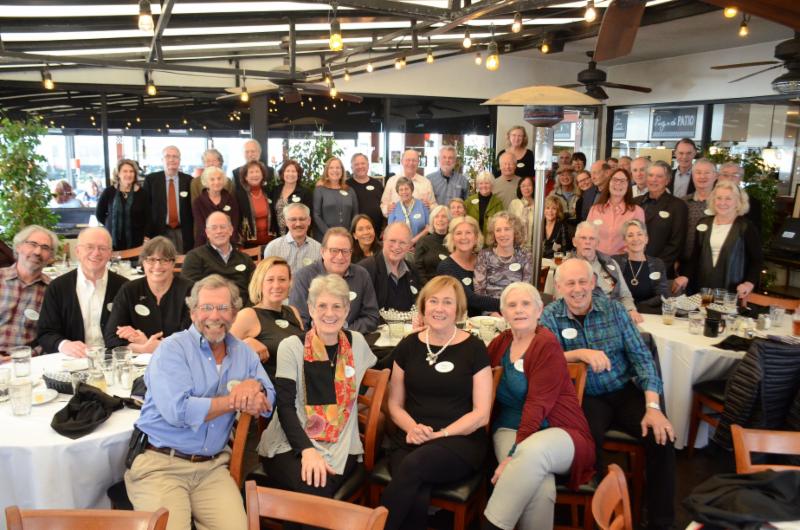
Reunion of the Indochina Peace Campaign (IPC) beforeTom Hayden's Memorial.

Make April 4th Matter


A Call to Break Silence


April 4, 2017 will be the 50th anniversary of Dr. Martin Luther King's historic speech, "Beyond Vietnam:  A Time to Break Silence."  In his dramatic address in Riverside Church at a meeting of Clergy and Laity Concerned About Vietnam, Dr. King argued that militarism and war abroad were undermining the struggle against poverty and racism at home.


He witnessed the anti-poverty program being "broken and eviscerated as if it were some idle plaything of a society gone mad on war."  He warned that a nation continuously spending more money on the military than on social uplift, "is approaching spiritual death".


This is a powerful message of enduring value.  It remains relevant today as our government considers greater American military involvement in the Middle East and the President urges "massively rebuilding" the military while cutting social programs.  It is also a reminder of how much our nation has forgotten the lessons of Vietnam and of the anti-war movement and incompletely addressed the humanitarian consequences of that war.


We call on religious organizations, community groups, labor unions, universities, schools, veterans, peace activists and civil rights advocates accross the nation to convene local events on this and future anniversaries.


Let us join together to re-read Dr. King's speech and reflect upon its powerful meaning for today, and let us follow Dr. King in speaking out against racism, poverty and war.

Organization and constituency leaders and individuals are invited to join this call by clicking here   http://tinyurl.com/VPCCcall

Three campaigns are underway with project ideas and resources for honoring the 50th anniversary of Dr. King's speech.

King and Breaking Silence (The National Council of Elders)  http://www.kingandbreakingsilence.com

Riverside Church  
The Shalom Center   
Our goal is to broaden their national outreach and to infuse the experience of peace activists into community programs around the country.

What groups are you a member of, or you can approach, with a simple but powerful idea to spiritually and politically deepen the disquiet and activism prompted by the Trump Administration?

  • To read the full text of Dr. King's speech, click here 
  • To hear the full audio, click here 
  • To see the speech divided into sixteen sections for dramatic group presentations, click here
  • To view Dr. King's speech being read last year by religious figures, activists and a member of Congress at Central United Methodist Church in Detroit, click here
 
Please inform VPCC through Terry Provance of your plans and to suggest effective ways to link the legacy of the anti-war movement to the 50th anniversary of "Beyond Vietnam: A Time to Break Silence".

Terry Provance ;   


*****************************************


Videos from the
 VPCC conference
and on the draft


"Vietnam: The Power of Protest" is a 50 minute video based on interviews conducted at the conference in Washington produced by Activist Video Archive.  It and the complete interviews of 43 participants can be seen here


The Draft and the Vietnam Generation, a 49-minute documentary by Beth Sanders, tells the stories of young men who faced being drafted to fight in a war they opposed. Their resistance to being drafted not only changed their lives, but shaped American history. Preview it here  www.thedraftproject.com  Purchase a download for at least $10 and the film maker will donate that amount to VPCC.


The Draft, an award-winning stage play by Peter Snoad, chronicles the diverse real-life experiences of 10 young Americans with the Vietnam War draft. The play was filmed during its Boston premiere and the resulting video can now be purchased through the Media Education Foundation. For a full preview, the trailer, a free discussion guide, and ordering information, please visit here: https://shop.mediaed.org/the-draft-p662.aspx. 

The script of The Draft can also be used in the classroom or for staged readings or productions of the play (more information at www.vietnamdraftplay.com). 

The Draft is based primarily on Tom Weiner's book, "Called to Serve: Stories of Men and Women Confronting the Vietnam War Draft" another valuable educational resource (www.calledtoserve.com).

*****************************************


Update on Trip to Vietnam, 
 Laos and Cambodia in 2017 

We have heard so far from nine persons interested in joining a group tour of Vietnam in 2017 (with Cambodia and Laos options) that will be organized by the Fund for Reconciliation and Development. It is designed for folks who were active in the peace movement and their families. It offers an opportunity to see the impact of the war, reflect with hosts on the role of anti-war activism, and experience fascinating cultures, histories, geography and cuisines. Meetings with government and US embassy officials focus on contemporary issues, including economic development, trade and the danger of conflict over territorial claims in the South China (a.k.a. East) Sea. Dates and itinerary will be determined in consultation with prospective participants who should write to John McAuliff


*****************************************


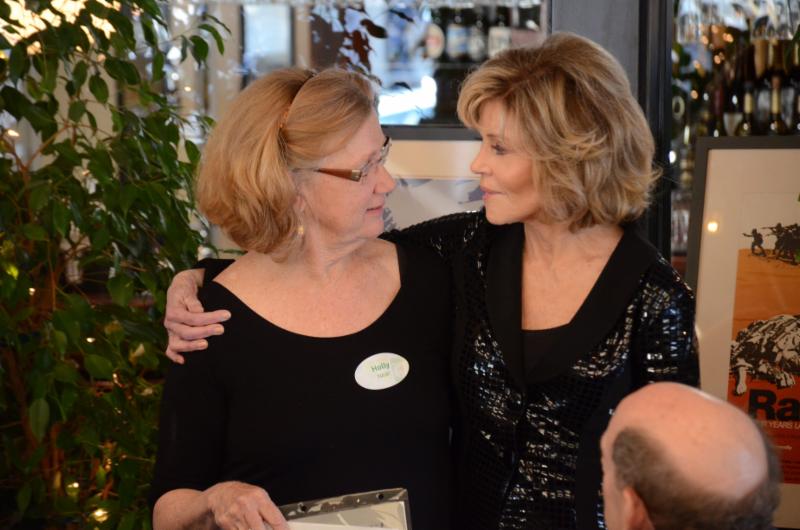
Holly Near and Jane Fonda at the IPC reunion.
(photos by Brewster Rhodes)


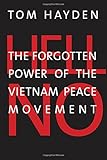
Tom's final book grew from his work on the letter to the Pentagon and the VPCC Power of Protest conference.  It is available in stores and from Amazon.   


Hell No: The Forgotten Power of the Vietnam Peace Movement
     by Tom Hayden
Yale University Press
168 pages

Buy Now


We need to raise at least $2500 a month to staff VPCC.  
Tax deductible contributions are warmly appreciated 

Click here to donate.

VPCC c/o Fund for Reconciliation & Development, 
64 Jean Court, Riverhead, NY 11901